When the NBA had to work out how to restart its season in the middle of the pandemic, it turned to this book. Eric Schmidt, Google's former chief executive, says Nudge changed the way he thinks about both business's and society's biggest problems. Governments on opposite sides of politics, David Cameron's Conservatives in Britain and Barack Obama's Democrats in the US, each set up a team to put the book's core idea to work.
What they all took from it is that the design of a choice, such as the box that's already ticked, the order of the options or the number of steps on a form, often decides what people do before anyone has said a word to them.
Nudge first came out in 2008. The 2021 Final Edition rewrites much of the original, but the core idea is the same. It's about the environment around a message, or that influences how people make choices. Somebody designs that environment every time, and there is no way for them to be neutral about it.
On first blush, this book is most useful to anyone designing or proposing policy, inside government or from industry. But on second read, it's more than that. It seeing, and understanding, how we are all choice architects in varying degrees.
The authors call whoever sets up a choice a choice architect. I'm guessing every one of us is one, in some way.
And once we are designing choices, we hold significant power, as the system or process designs can be more influential than the policy itself.
Evidence of this is found in what Thaler and Sunstein call, "the most famous chart in social science, which we spend some time with in the episode. The chart contrasts European countries grouped by their default consent rules for deceased organ donation.
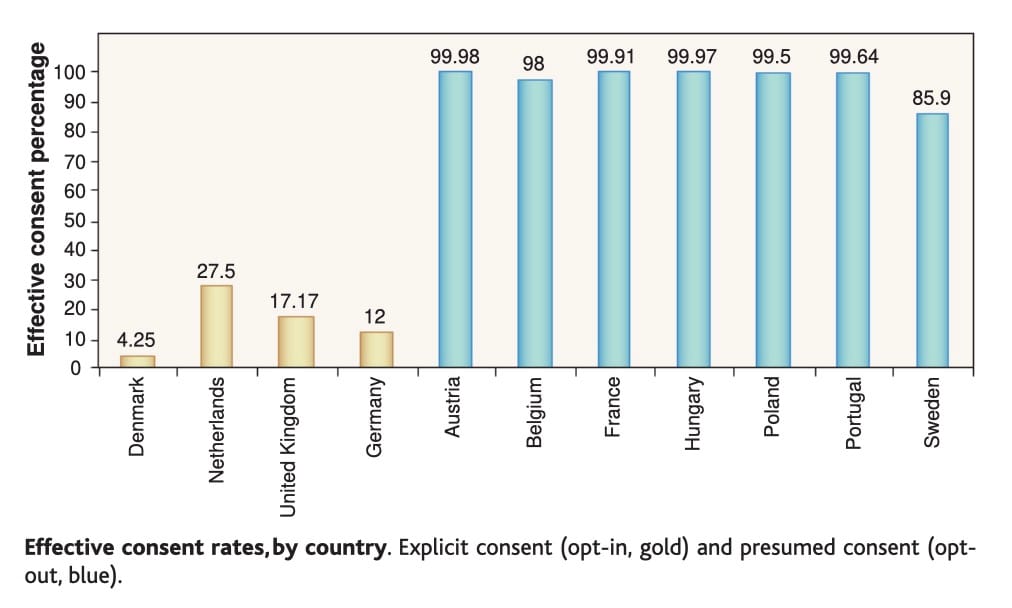
What should we make of this data? I break it down for you in the episode.
What We Cover in the Episode
- The boss of a Swedish pension fund bought the most expensive house in the country and a helicopter, and when fraud allegations broke, 98.6% of the fund's investors left their money where it was.
- A thought experiment about Caroline, who decides how food is laid out in a city's school cafeterias, and how there is no way for her to arrange it that doesn't change what the kids eat.
- The authors separate Econs, the flawless deciders of economics textbooks, from Humans.
- In a coffee mug experiment, owners demand about twice what buyers will pay, and that gap says something about why people stick with what they have.
- Organ donor registration sat at 12% in Germany and more than 99% in Austria, in what has been called the most famous graph in social science, and the design difference that explains the gap (see the chart above).
- A thermostat test at the OECD's headquarters in Paris shows where a default stops working.
- Four side-by-side examples, from fruit placement to calorie counts on menus, show what a nudge is and how it differs from a mandate or a tax.
- In the Swedish pension system behind that story, a national ad campaign beat the government's default fund at launch in 2000, and over the next 20 years the default won anyway.
- Also, we learn that Harrison Ford was used in some of these ads. Seriously, what authority does he have? Well, you'll recall from our Influence episode, this is a mental model many of us fall for (The Authority Shortcut, as I called it).
- Nova Scotia passed a presumed-consent law for organ donation in 2021, and the episode asks whether the registry and hospital changes built around it mattered more than the law itself.
- The episode draws out three mental models: the default is not the preference, sludge is policy, and tell people what their neighbours actually do.
- It takes on three misunderstandings: that nudging is sneaky, that people should simply be left to choose, and that nudges are too small to matter.
- Why the person designing the form may influence behaviour more than the people who wrote the rule or the law itself.
Bonus: ideas that didn't make the episode
Ask people when they'll vote, and more of them do
For years, get-out-the-vote calls asked one question: are you planning to vote? In the 2008 US primaries, the political scientist David Nickerson and the behavioural scientist Todd Rogers tested three follow-up questions. What time do you expect you'll head to the polls? Where will you be coming from? What will you be doing before you go? The idea came from the psychologist Peter Gollwitzer's research on "implementation intentions," which found that people are more likely to follow through on a goal once they've made a specific plan for it. The follow-up questions raised turnout by 4.1 percentage points. Asking supporters whether they've made a plan to vote is now standard practice on campaigns.
A few early voices can decide which side a party takes
The sociologist Michael Macy and his colleagues at Cornell split thousands of self-identified Democrats and Republicans into groups and asked their views on 20 issues chosen because neither party had an obvious position on them. In some groups, participants could see how members of each party had answered before them. In those groups, the parties often ended up on opposite sides depending on what a handful of early respondents happened to say, and the same issue could land on the left in one group and the right in another. The researchers' phrase is "chance variation in a small number of early movers." It's a useful companion to Episode 16, on polarization.
Make it feel like a game
I think this is behind a lot of the ethical gamification I've tried in public engagement over the last couple of years.
The authors argue that people will happily do something if it feels like a game, and some governments have tested that. New Taipei City in Taiwan entered dog owners who deposited their dog's waste in special bins into a lottery for gold ingots, with a top prize worth more than $2,000, and the city reports that dog fouling on its streets fell by half during the program. Lotteries work because people love them, but the authors say the details matter. The Netherlands runs a state lottery drawn by postal code, so if your postal code is drawn and you didn't buy a ticket, you know you would have won. The authors' point is that the lottery is designed around regret.